Drunken Chicken

The idea of drunken chicken sounded kinda good to me… Boiled chicken, marinated in Chinese rice wine, then cut into pieces and eaten with plain rice.

Well, it wasn’t.

Blog warning: graphic, unpretty photos of grey chicken meat below… I know you all come here for my amazing kick-ass photography skills, and I do admit I should probably get some kind of award for it, but even I, with my amazing, elite ability (it’s like a superpower) cannot make a boiled chicken look good. I’d imagine it’s totally beyond the realms of physical possibility, to be honest, because if I can’t do it… well. You know.

No photo of the chook in its packet this time – it looks exactly the same as the chicken in the last week’s recipe, so here’s the costing:

Tesco’s chicken : £3.33
Ginger : 21p
Spring onions : 50p
Rice wine : technically free because it was already in the cupboard, but for 300mls goodness knows

Grand total : £4.04

The method for this is fairly simple – but, it does take several days to actually make this dish.

First of all, you stuff some ginger and spring onions up old chooky’s bum, and place it in a large pan and cover with water. Bring to the boil, skim, and cook for 15 minutes.

Here’s the scary part. When the 15 minutes are done, you have to put a lid on the pan and leave it, off the heat, for three to four hours. The remaining heat in the water will continue to cook the chicken until it’s peachily perfect and deliciously tender. Dare I do it? Dare I risk salmonella on a cheap £3.33 chicken?

Yes, of course!

Week Four: Drunken Chicken skin-on

It went surprisingly well, actually. Here’s the cooked chook with its skin still on – you have to remove it for this recipe, but the naked corpse was a bit too gruesome for a closeup… As you can see, the drumsticks are falling away from the body, which is a pretty good indication that this is cooked through properly. I also pierced the flesh to make sure no pink liquid ran out – it didn’t. We’re good to go!

Now, all that cooking liquid left over isn’t going to be wasted. That’s perfectly good chicken stock. So, we save that and reserve 300ml for our chicken.

Week Four: Drunken Chicken jointed

Next step was removing the skin and jointing the chicken. I’ve never jointed a whole chicken before so I got really nervous and started looking it up in books and looking at YouTube videos to see how it was done. Of course, I forgot that this chicken is already cooked, so it’s much, much easier to joint it. Several times during this I simply used my hands. Yum!

Now, this is where I cheated somewhat, so I can only speculate as to how delicious this would have been if I had simply followed the instructions. Instead of salting my chicken now and leaving overnight, I had already done it. That’s right! I rebelled and salted the whole cooked chicken, leaving in the fridge overnight so I could take better pictures of the jointed bird. Now, I know you are overwhelmed by my stunning piece of photography above and can see how it was totally worth doing this, but you didn’t have to eat the result.

So, skipping the salting bit, because I’d already done it, it’s time to add the marinade to the chicken. It’s now day two, and once we add this marinade, the chicken has to sit for two to three days.

Week Four: Drunken Chicken marinade

The marinade is 300ml of rice wine and 300ml of chicken stock. You can add 2tbsp of brandy if you want. I didn’t.

Now, there’s nothing to this but to leave everything in the fridge, and turn it every so often, dreaming of the delicious chicken you will no doubt be eating – after all, the more complicated and time consuming the dish, the better the results, right?

Nope. After three days sitting in the fridge, this chicken pretty much tastes like you would expect it to taste. Pretty alcoholic. Maybe you need fancier rice wine, maybe you need to be a bit of an alcoholic yourself, but I wasn’t impressed.

Week Four: Drunken Chicken meal

I salvaged this somewhat by serving it with that amazing ginger and spring onion dipping sauce I told you about here, but in all honesty, it was fairly overpowering.

So, the scores.

M gave it 2.5. After being coaxed with the dipping sauce, he gave it 4. Anything below a 5 we had already agreed is in ‘don’t bother making it again’ territory. So, this is the last time in my life I will ever make this dish. I’m not sad.

I gave it 4. It wasn’t really really bad, but it in no way paid off the planning involved in a dish that takes at least four days to prepare.

However, it did give us some lovely chicken stock and PLENTY of leftover chicken…

Bento cups

Bento cups are one of those cute bento accessories that I have a lot of but never seem to use up. Maybe because I just love buying them so much…

Assorted dividers

As you can see, bento cups come in loads of different shapes and sizes. Sadly, all those cute patterns you see inside get hidden once you pack your bento box, so, although it’s hard, try not to select your cups on the basis of the bottom! Much better is to look at the top centimetre of the edge, as this is usually all you’ll see of your bento.

Oval dividers

When it comes to types of bento cups, there are five main kinds. There’s your standard paper bento cup which has a wax/plastic lining to stop food leaking. You need to throw these away after you’ve used them though, which is a shame. There’s your silicone bento cup which is actually heat proof and reuseable, which are massive bonuses – however, the drawback is that they don’t have patterns on them and are always solid colours. They will bend to the shape you want them to – within reason – so they’re very handy for slotting into your bento. There’s hard, rigid plastic cups which usually come in a particular shape, like a tulip flower or an elephant head or something like that. They can be difficult to fit, and there’s the same drawback with silicone cups of not having patterns on them. Unlike silicone, they’re not heat proof, but you can reuse them. There’s also foil bento cups, which you can use to heat food in. They’re disposable and I’ve found also pretty flimsy. To be honest, I’d always rather go for a silicone cup than a foil bento cup, because they’re sturdier and reusable. Then there’s your makeshift bento cups – the type you might fall back on if you can’t get hold of any bento supplies. Cupcake and muffin cases make good substitutes, and you can get some really cute ones. However, unlike bento cups, if they’re going to have any kind of coating to prevent leaks, it’ll be on the outside of the cup, instead of the inside as with real bento cups. You should save cupcake and muffin cases for food which isn’t soggy at all.

 My creation

Here you can see some bento cups in action. The left hand side shows two rigid bento cups being put to good use on some soggy side dishes. Silicone would also do great here, but you can have mishaps with it sometimes as it’s so pliable. On the top right hand side, you can see a corner-shaped bento cup. See what I mean about the top edge? If you can, before you start packing, try to pick bento cups that match your bento box – whether it’s a complimentary colour or a contrasting one. It’ll definitely make a difference to the finished bento. On the bottom right, you can see a silicone cup which has been used to cook an omelette-type mix of eggs and veggies. Very handy things, silicone cups!

Green bean, sweet potato and soy and balsamic vinegar chicken bento

I love the penguin pick in this bento. I bought it from J-List in a pack of sea-creature food picks, but I think the penguin is my favourite.

Inside this bento is a mixture of different recipes I was trying out for the first time. I think the sweet potato was a recipe from Wagamama, and included a honey and lime juice dressing. I’m not big on sweet potato, to be honest, and this one didn’t really sway me to the cause. This bento picture was actually taken over two years ago, and as you can see, I’d still not really perfected the art of packing onigiri… Ah well.

The orange bento box is from Daiso, and even though it’s one of the cheapest ones around, it’s still my favourite because it’s such a nifty oval shape. The front tier contains soy-balsamic chicken and spicy green beans, both adapted from Harumi’s Japanese Cooking – both of her English cookery books are great, although I prefer the second one!

Green bean, sweet potato and balsamic chicken bento

Spicy green beans


INGREDIENTS

  • 150g green beans
  • 75g minced pork
  • 1 tbsp garlic oil (or use olive oil and some garlic puree)
  • Pinch dried chilli powder
  • 1 1/2 tbsp soy sauce
  • 1/2 tsp sugar

METHOD

  • If making for the bento, trim your green beans (or French, or fine…whatever you call them!) into halves or even thirds, so they can be picked up easily by chopsticks.
  • Boil for about four minutes, then drain and refresh quickly in very cold water. This is to retain their colour. Drain again, and shake off excess water.
  • Heat the garlic oil in the pan and add the pork, stirring to break up. Now add the chilli pepper and stir well to coat, then add the soy sauce and sugar.
  • Mix well, ensuring the sugar has dissolved, and then serve the beans with the mince on top.

Note

You can increase or decrease the chilli powder according to your tastes, just ensure it’s all mixed in well or someone will be getting a surprise in their bento box…

Soy and balsamic vinegar chicken

INGREDIENTS

  • Six chicken thighs
  • 4 tbsp dark soy sauce
  • 2 tbsp balsamic vinegar
  • 2 tbsp sugar
  • 1 tbsp oil

METHOD

  • Mix the soy sauce, balsamic vinegar and sugar in a pan, then simmer. Allow to cook for several minutes, reducing the sauce until it’s thick and glossy.
  • Now wash and dry your chicken thighs, and place them in a hot pan with the oil, and allow to brown on one side. Turn them over and pour over the sauce, then cover and cook for five minutes, taking care not to let the sauce burn over too high a heat.
  • Remove the chicken and test it’s cooked by slicing a piece in half. Return to the heat if it needs longer.
  • For a bento, allow to cool before slicing and dressing with some extra sauce.

Note

You will need about one or two chicken thighs, depending on size, per person for a bento lunch.

These recipes originally appeared in 501 Bento Box Lunches, published by Graffito Books.

Gyoza and hot soy sauce cucumber bento

I love making Japanese pickles – unlike western pickles, these aren’t preserved vegetables, but are soaked in a preservative liquid for a couple of hours, or overnight. This recipe produces a spicy delicious pickle that goes really well with rice and gyozas.

Gyozas and cucumber

Recipe for hot soy sauce cucumber

INGREDIENTS

  • 1/2 cucumber
  • 1/4 tsp salt
  • 1 tsp mirin
  • 2 tbsp soy sauce
  • 1 tsp English mustard

METHOD

  • Halve the cucumber and scoop out the seeds. Cut the cucumber into half moon chunks, salt and leave to stand for 20 minutes in a covered bowl.
  • Take a plastic bag and add the remaining ingredients, mixing well so that the mustard is dissolved. Add the cucumber and mix well, then refrigerate until needed – leaving for at least 10 minutes. Drain well before adding to a bento – best used the same day or the day after.

This recipe originally appeared in 501 Bento Box Lunches, published by Graffito Books.

Product Placement: Onigiri Sponge!

I know a lot of bento makers buy their bento stuff from J-List – and a lot of us also run affiliate programs with the company, whereby if you click on a link from our sites and purchase items, we can gain store credit or cash in return. I’ve also set up an affiliate program here just like at Bento Business – if you want to support the site, you can do so right along at the same time as feeding your bento obsession by clicking here. (You can also reach the site without taking part in the affiliate program by clicking here.) Whilst browsing today, I came across this super cool kinda-bento related item I just had to share, because it’s so damn cute!

This, my friends, is an onigiri kitchen sponge! Let’s pretend it’s totally practical and wouldn’t be at all weird and creepy when you actually start using it and its face gets all dirty and brown… Sometimes, the truth just hurts too much.

J-List claims you can use this for bathtime fun as well… Okay, it’s cute, but I don’t know how much fun can really be had with a novelty sponge (or am I missing something?) You can also get a banana version… Has anyone got one of these things? They’re fricken awesome!

Thus ends the word from our sponsors… normal service will now resume!

Hampshire Farmer’s Market – part two!

Multicoloured carrots

I love the farmers’ market. This is a photo of one of my favourite veggie stalls, Secretts. My favourite thing they sell is these purple, yellow and orange carrots, but they also do a really good pick and mix leaf salad as well. Purple carrots are cool, but to be honest, when you peel them, a lot of the purple skin comes off. It’s only purple on the surface! And, when you cook them, the purple gets a little muddy. Multicoloured carrots are pretty – but weirdly, carrots weren’t commonly orange until they were bred that way by the Dutch in the 17th century – orange for the House of Orange, you see. It’s probably cooler if you’re a 17th century Dutchman, I guess…

Red spring onion

Secretts also sell red spring onions, which are a favourite around here, and I also spotted some really pretty radishes. Multicoloured veggies are so beautiful and appetising when they’re raw – can you imagine using these beauties in a bento box, for example?

Secretts Easter Egg radishes

I wish I was the kind of person who could walk around a market and carefully pick one amazing piece of produce, then come home and lovingly create a gorgeous dish centring around it, so I can enjoy it at its absolute best and congratulate myself on being a fantastic person all round. Instead, I’m the kind of person who buys everything in sight and hordes vegetables in the fridge, and only uses them when they’re wilted and nearly ready to die a death in the bin.

Isle of Wight garlic

So, I promised to tell you all about Isle of Wight garlic. This is some phenomenal stuff, I tell you. It’s grown on The Garlic Farm, which also has its own online shop, bricks and mortar shop, cafe, and even its own festival. You can buy seed garlic from them, as well as regular garlic bulbs (actually, enormous monsters), elephant garlic (even bigger!), purple garlic, and my favourite, smoked garlic.

Oak smoked garlic

As well as all this, they also make a range of pickles, chutneys and relishes, which I highly recommend and have also won a few Gold Taste Awards in their time. My favourite is Vampire’s Revenge, a hot chilli and plum combo which is fantastic with cheese or ham. Sadly, I’m the only one around here who eats pickles and chutneys, so I can’t buy it often, but when I do, it’s heaven. Maybe come Christmas, eh?

Purple garlic

As you can see, the purple garlic is a true thing of beauty… Ah, mother nature. So stylish and good at matching colours, you are. Just like me, in fact! (Snark.)

Another one of my favourite sellers is The Tomato Stall

Tomato stand

One of their specialities is oak-roasted tomatoes, smokey, oily little nuggets of sun-ripened sweetness in a tub. These are also bloody fantastic with cheese, and have to be bought in strictly limited quantities to prevent me turning into a heifer and being dragged off to market myself. The Tomato Stall has a blog with a post all about how these beauties are made, and what to eat them with, so check it out if your taste buds fancy a good old teasing.

Cherry tomatoes

It’s physically impossible for me to look at tomatoes too long without wanting to eat them, so it’s not surprising I was a sucker for these golden cherries – must be tried? Then please, my good man, fill up this bag with them so I may feast!

Salt and tomatoes... heaven

That’s exactly what I did, and I took them home and ate them with my fancy fleur de sel de Guerande (best sea salt in the world, don’tcha know?). Tomatoes and sea salt are delicious. I don’t care about hypertension. (Might I also add, the old salt and tomatoes trick was taught to me by the same dear old nan who used to put sugar in my coca cola to ‘get rid of the bubbles’? We’re all about health around here.)

All that and I still haven’t covered all the neat stuff at the farmers’ market? Hmm…

Inari Sushi bento

This pretty little bento is one of my favourites – it’s elegant and healthy… completely unlike me! Inside is sesame vinegar aubergine and spicy soy sauce cucumber, as well as soy sauce and balsamic vinegar chicken.

Inari sushi bento

Recipe for inari sushi


INGREDIENTS

  • 2 cups hot, cooked Japanese rice
  • 3 tbsp liquid sushi seasoning
  • 1 tbsp black sesame seeds
  • 6 inari skins

METHOD

  • Pour the sushi seasoning over the rice, then turn and fan until cooled and no longer steaming. Leave to get completely cold before stirring in your black sesame seeds.
  • Open your packet of inari skins, and slit open along the longer side, carefully pulling the edges apart to make a pocket. Fill with the rice and place in the bento rice side up.

Notes

You might want to trim the inari skins down so that they fit in your bento, as some can be taller than your bento is deep. Generally, cutting them in half will make them the right size. Or, you can simply lay a full size piece on its side.

This recipe originally appeared in 501 Bento Box Lunches, published by Graffito Books.

A Halloween cupcake preview…

Over the weekend, I’ve acquired some food colouring paste, numerous sprinkles and cupcake cases, and an obscene amount of butter, sugar and eggs. I’ve also learnt how to mould fondant into mini pumpkins (and, more importantly, found out what fondant is and where to buy it from). All of this is for a good cause…

Halloween cupcakes

More cupcakey Halloweeny goodness when it’s actually October… I just couldn’t resist posting these babies now!

Hampshire Farmers’ Market

One of my favourite things to do is go to our county’s farmers’ market, which is held on Sundays. The best one is held in Winchester (home of King Arthur’s Round Table… sadly not actually the real King Arthur, but still, cool enough!) on the second and fourth Sundays of every month, and man, is it big. There are loads of stalls, selling the best of the produce grown here on the south coast of the UK, where (even though I am biased) I have to say, it’s a little sunnier and warmer than the rest of the country.

Flowers

The market doesn’t just sell meat and vegetables – there are plenty of stalls selling flowers, cakes, bread, pickles, wine, cider, liquors, hot chocolate… you name it! Although I don’t have money to spend at the moment on beautiful flowers, a picture lasts longer, right? Check out that gorgeous autumnal display at the back!

Although when I went to the market it was at the end of August, autumn was definitely creeping in – I had to take some photos of this gorgeous sugar pumpkin reclining with its bed-mates… right before I bought him, of course.

Sugar pumpkins

Pumpkin is one of those things I love but never seem to eat enough of. I would love to eat this beauty in a delicious Thai-style coconut soup… or maybe in a sweet, creamy risotto…

Little gem squash

These guys, though, you can enjoy simply cutting off the top, scooping out the seeds and replacing them with a drizzle of olive oil and a dot of butter, plus seasonings, then baking in the oven. They were delicious – and called ‘Little Gem squash’ – how could I resist?

Blueberries

Hampshire also grows some pretty nice blueberries. I love blueberries! Unfortunately, by the time I got mine home, they had fallen out of the open punnet and gone all over the bag. Luckily, I knew just what to do, thanks to Nigella’s Express…

Squashed blueberries

Cook ’em with maple syrup and eat ’em with pancakes, of course… I’ve got three blueberry bushes in my garden, and so far I’ve harvested two berries, directly into my mouth. I think they need bigger pots…

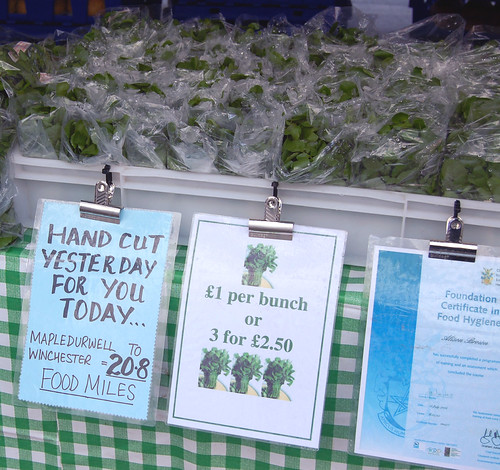
A real Hampshire speciality, though, is watercress. Hot and peppery, it’s a semi-aquatic plant that thrives in what look like overgrown ponds, but are actually watercress fields, I guess. Alresford, Winchester, is supposedly the ‘watercress capital’ of the UK, and there’s even a railway line called the Watercress Line named for it, which used to carry the watercress harvest to London.

Hampshire watercress

Did you know that watercress is one of the oldest known leaf vegetables eaten by man? (Thanks Wikipedia!) In the UK, we don’t just eat watercress in sandwiches. We’re also pretty good at making watercress soup and watercress pesto – and even watercress pate, crepes and shortbread.

Hampshire watercress soup

Cresson Creative is probably the most prominent watercress seller at the market, and they also have a catering company as well. Their crepes are delicious!

I’m all farmers’ marketed out now, but I still want to tell you all about Isle of Wight garlic (the best!) and my favourite meat and vegetable stalls at the market. Stay tuned!

Nikujaga bento

Nikujaga is Japanese comfort food – the sort of thing cooked by mothers for their children in winter. It’s not usually served in bentos, but you can always reheat it the next day for lunch – or eat it cold! It has a sweet, salty taste which is absolutely delicious.

Nikujaga bento

To make this bento, you need carrots, tomatoes, soy sauce eggs, edamame beans, a piece of rolled omelette, cooked Japanese rice, furikake and nikujaga, made with the recipe below. You also need an onigiri shaper, a vegetable cutter, two bento cups and a two-tier bento. About an hour before you make the bento, prepare the quail eggs by hard boiling, peeling and soaking them in some soy sauce.

Place a small amount of drained nikujaga in a bento dish on the bottom layer of your bento box, and fill the remaining space with an onigiri rolled in furikake. On the top layer, place your rolled omelette in a small bento cup, and place pieces of carrot along the side which have been cut into little shapes with your cutter. Then, alternate the soy sauce eggs with tomatoes, and fill the remaining space with boiled edamame beans, sprinkled with a little salt.

Recipe for nikujaga

INGREDIENTS

  • 250g thinly sliced beef brisket, cut into small pieces
  • 700g potatoes, peeled and cut into small chunks
  • 2 small white onions, peeled and cut into small wedges
  • 1 tbsp oil
  • 600ml dashi
  • 4 tbsp sugar
  • 5 tbsp light soy sauce
  • 2 tbsp mirin
  • 1 tbsp sake
  • Chives
  • Seven-spice

METHOD

  • Heat the oil and cook the potatoes for two minutes. Add the meat and onions, stir well and cook for another two minutes.
  • Add the dashi, sugar, soy sauce, mirin and sake and simmer the mixture with a drop-lid on top until the potatoes are cooked though – this should take about 15 minutes.
  • For a bento, allow to cool before straining off most of the liquid and placing in your bento. Cooling the mixture in the liquid allows the flavours to deepen. When eating, you can have it cold or reheat it. Nikujaga is far from traditional bento food, but you just might find you like it cold the next day!

Note

If you don’t have a drop lid, you can make one by using a lid which is slightly smaller than the inside of your saucepan. Or, use a piece of greaseproof paper with a small hole cut in the middle for a vent.

Fruit, rice and nikujaga bento

This recipe originally appeared in 501 Bento Box Lunches, published by Graffito Books.