Schmalzy Chicken

This week’s chicken was a relatively simple affair. I decided to invite dear old mum and dad over for lunch, so we could swing by St Francis, a local animal rescue centre, where they were putting on a fund raising event. We’d (well, they) just adopted a lovely new dog by the name of Ben, so we decided to take him back to see all his old chums. He had an absolute blast, being treated like a right celebrity.

Anyway, that’s beside the point – the point was, I decided to make the chicken recipe simple, because I was serving it as part of a traditional British Sunday lunch. Americans, this is what we also eat at Christmas – only a much more elaborate version. It’s also the nearest thing you get to a Thanksgiving style meal here – swap the turkey for the chicken, and you see what I mean.

So, the recipe was Nigella Lawson’s Schmalzy Chicken, which is from possibly my favourite book of hers, Feast. The recipe is simplicity itself, and I don’t think I’m going to get a cheaper chicken dish out of this entire year – mostly because I bought one of Tesco’s ‘3 for £10’ chickens. Well, two, in fact. And lamb steaks.

Week Three: Tesco Chicken

So, that’s the semi-abused chicken. And here’s the costing:

Tesco Chicken: £3.33 (to infinity)

Grand total: £3.33

Yep, that was all I bought. The recipe calls for salt and a chicken. I’m down with that.

The idea here is that you render down the chicken fat you find inside the carcass, and then rub it over the chicken and roast it, so that the chicken gets meltingly tender and soft, and all deliciously savoury. I had a cunning plan to use three times the amount of chicken fat you would normally get from a chicken, by saving the fat from the inside of next week’s chicken. But, I didn’t tell M and he threw it away. Foiled! The other third was generously donated by the fat I skimmed off the top of Jamie’s chicken broth.

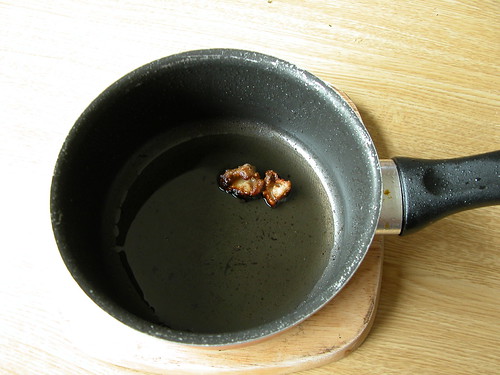
Rendering the chicken fat

Rendering the chicken fat is just  a fancy way of saying you cook it until all you have left is a pool of ‘schmalz’ and a wizened little piece of chickeny stuff. You can eat this, or shove it up the chicken’s bum to flavour it. That’s what I did…

Week Three: Pre-Schmalzy Chicken

This is the chicken pre-schmalz, sitting in the roasting pan that M’s mum gave me. It makes the chicken really moist thanks to the lid, but it also had the side-effect of not letting the chicken brown so much all over.

Week Three: Schmalzy Chicken

At first glance, this doesn’t seem like so much of a triumph, but that’s because you can’t taste it. Moist and delicious! The taste wasn’t complex at all, but somehow more ‘chickeny’ than chicken normally is… Amazing! And, with a cheapy chook, too. I wouldn’t say this was a miracle, but it certainly was a revelation. Shame I couldn’t get the skin any crispier, though – should have left the lid off.

Week Three: Proper British Roast with Schmalzy Chicken

This was the meal we ate our chicken with – a good old roast. Peas, fancy carrots, roast potatoes, stuffing balls, pigs in blankets, and gravy. Delicious.

So, the scores.

My dear old mum gave it 9. She would – everything I do well reflects on her, of course. Any chicken cooked by a child of hers is sure to score no lower than a 9.

My dad gave it 8. Very tasty and moist, he reckoned.

M gave it 7. It’s a simple recipe, and a simple, clean taste, but there’s nothing spectacular about it.

I gave it 7.5. It’s easy to do, tastes good and is cheap – what more could you want? Shame I couldn’t brown it all over, cos with crispy skin this could have been really special.

There wasn’t much leftover chicken here, but what there was got made into the most unphotogenic curry you ever did see. Except you’ll never see it, hah.

Bento photography – Part One

Like a lot of other bloggers, I do occasionally get asked how I take good food photos. In fact, more than being asked about what a bento box is and why I bother bentoing at all, more people ask me what kind of camera I use and how I take such great shots. I’m very flattered that my photography is good enough to prompt this question – and the answer is sort of good and bad at the same time. As far as I’m concerned, you don’t need any special skill (that’s the good part), but you do need a good camera (that’s the bad part). I know there are some amazing photos taken on Flickr with even very basic point and shoot cameras, but to do a really amazing job, you need a digital SLR camera. Basically, an SLR allows you to see through the viewfinder exactly what you will be taking the photo of, so there are no surprises. It sounds simple enough, but usually digital SLRs are packed with a load of other features you’re going to find useful in taking good food pictures.

The camera I use is a Nikon D50, which is now discontinued. It’s actually my dad’s camera, so I’m currently in the process of whining at various people to try and get myself one so I don’t have to keep borrowing his (sorry dad!). The D50 has now been replaced with the D40 and D60, the former of which is cheaper and doesn’t have as many features and the latter of which is more expensive – so I have been told. But other food bloggers have their own favourite cameras, so it’s really down to finding one you can afford, explaining to whoever you’re buying it from what you want it for, and doing research.

If you can’t find yourself a fancy-schmanzy camera, but you do already have a digital camera, you can do a search on Flickr (I really recommend this website for photo sharing, it’s a total blast! You can find me here.) to find out what kinds of photos are being taken with a camera like yours.

 Locate your camera

As you can see, you can the camera type by clicking to the right hand side of the screen. Flickr registers your camera automatically, so you don’t have to add this information by hand. If you click on it, you’re taken to another screen which shows you more about the camera, its popularity, and it will show you some fantastic recent photos taken using that camera.

 Find out what other images are being taken

Even if you don’t have a fancy camera, you’ll still find some amazing work being uploaded that should give you hope – yes, it is possible to take good photos with anything! It’s just easier to take good photos with no skill when the camera is super-expensive… or so it seems to me. Anyway, I recommend that if you see a superuberawesome photo you want to replicate – get in touch with the person who took the photo and see if they can give you any help. You never know!

Another good tip is to use a variety of backgrounds to compliment your bento boxes. You can get cool backgrounds from so many different sources. I’ve used pillowcases, tea towels, bedsheets, bento bags, furoshki, placemats, fabric scraps and scrapbooking paper before. Bamboo sushi roll mats are good, and so are wooden tables (or floors!).

 Saffy and bento

Don’t shy away from bold, bright colours and patterns. As most bentos are naturally colourful, contrasting colours can work a treat. As you can see from the image above, I gather a variety of different backgrounds together when I’m taking photos, to see which one looks best.

 Kitty Bento

As you can see, different backgrounds can change the look of the image, so it’s definitely worth investing in some to bring your images to life. White board is of course the classic, but I’ve used the back side of plastic mats before to replicate this without having to go all the way out to a stationery or hobby shop to get big pieces of card.

Soon, I’ll write another bento photography post about lighting and Photoshop!

Yakitori bento

Yakitori chicken is perfect bento food – short skewers of chicken and baby leeks drizzled with a sweet savoury sauce. You can cook your chicken on an ordinary bamboo skewer, then when cool, rethread onto another, fancier skewer – try using a hors d’oeuvre pick for a really fancy look.

Yakitori bento

To make this bento, you also need to make a devilled egg. Simply hard boil an egg, then slice in half and remove the yolks. Mix the yolks with ¼ tsp of your favourite Indian curry powder, 2 tsp mayonnaise and some chopped parsley. Then, return the filling to the gap where the yolk was, and top with more parsley.

You also need to cut out some shapes from thinly sliced carrot. As well as this, you’ll need lettuce, curly parsley, cherry tomatoes, cooked Japanese rice and furikake.

Fill the bottom layer of your bento with the rice, then add a line of furikake. Line your top layer with lettuce, and nestle your rethreaded yakitori chicken to one side. On the other side, place your devilled egg, then fill any gaps with the carrot shapes, parsley and tomatoes.

 Recipe for yakitori chicken

  INGREDIENTS

  • 6 boneless chicken thighs, or 4 chicken breasts
  • Bunch spring onions or packet young leeks, washed
  • For the sauce
  • 300 ml light soy sauce
  • 150 ml mirin
  • 100 ml sake
  • 100 g sugar
  • Japanese seven spice powder (or paprika)
  • Bamboo skewers, soaked

METHOD

  • Firstly, make the sauce by simmering the ingredients in a saucepan. This could take as long as 20 minutes, but make sure it doesn’t overcook and burn. You want the sauce to be thick enough to cling to the chicken when it grills.
  • Cut the chicken into small cubes and cut the spring onion or leek into similarly sized lengths.
  • Skewer the chicken and leek alternately onto your soaked bamboo skewers.
  • Put your chicken skewers under the grill and allow the chicken to go white on both sides. Now brush on your thick yakitori sauce and continue to grill until the chicken is brown and glossy, basting as you go along.
  • Once the chicken is a rich, glossy brown, it should be cooked in the middle and ready to serve. Sprinkle with Japanese seven spice powder.

Notes

Don’t squash the chicken up against other pieces of chicken – you want a little space to ensure all the meat is cooked through. The leek in between each piece of chicken will help to separate out the meat and ensure the finished dish looks colourful.

This recipe originally appeared in 501 Bento Box Lunches, published by Graffito Books.

Butterfly bento


Butterfly bento, originally uploaded by Bento Business.

I bought this cool nest of storage boxes in Paperchase a while ago and had to try them out. I also picked up a load of butterfly food cutters, and as my parsley on the windowsill is flowering like mad I thought I’d make a garden bento. I think I used too much bright orange cheese in this one though!

Here we have cheese, ham and nori spiral rolls, tomberry skewers, hamburger and cheese patties, rice and ham and cheese cut-outs.

Although this mushroom storage box is not really a bento, I think it shows off really well that you can use anything to house a bento lunch. I really like round containers, too. And single tier bentos are much easier to design and pack. Yeah, I’m lazy…

Getting ready for Halloween…

Did I mention that I love, love, love Halloween? Well, I do. I really, really do. The dark nights, the ghost stories, the crazy outfits, the pumpkins. The fact that Christmas is coming and the air is getting cool enough to wear scarves and hats and massive coats – my favourites! The fact that Bonfire Night is coming too, and with it firework displays and standing with a cricked neck for half an hour in the dark and the cold. I love Halloween – it’s like a portal to the winter months.

Getting ready for Halloween...

Here’s my latest Halloween purchase – last year it was all about buying my aristocratic vampire outfit… this year, it is all about CAKES. Halloween cakes! This year, I cannot celebrate Halloween without cupcakes. I’ve bought a piping bag and everything… Stay tuned.

Evolution of bento

I’ve been making bentos now for over two years, and along the way I’ve picked up some tricks. I’ve also contributed to a recipe book, had an interview with the Financial Times, and I’ve done an excruciatingly embarrassing interview with ABC News that was so bad they never even showed it. There’s even an article out there on a German magazine website about my bento making. How the hell did that happen?

I’ve come a long way.

For all those bento makers out there, I thought I’d show you just how far I’ve come, by posting my first ever bento, and my most recent.

Teriyaki beef and pickles

If you think this is embarrassing, you should also know that I used this picture in NEO for the Chopsticks recipe section. Ah, my poor readers – so sorry. Now, I’ve figured out how to take better shots by actually doing my recipes during the day… You cannot beat daylight for good photos.

So, want to see what two and a half years of bento making can do?

Cat bento 3

Tah dah! Yes, I’m very proud of how far I’ve come. I’ve learned how to compose pictures better, arrange bentos better, balance them better, and even make chara-ben. My photography has improved, and of course, my bento collection is massive. So, if you ever feel like your bentos don’t come up to scratch, just keep at it! If I can do it, anyone can.

To be honest, it’s all in the photography. Your bento can be the most amazing bento ever, but if you take your shot at night, it’s almost guaranteed to look bad. Natural lighting, people, natural lighting!

Also, it helps to look around at what other people are doing, and take inspiration from their fantastic photos. Give credit where it’s due and celebrate people’s ideas – the mini hamburgers with the knife and fork pattern came from an idea I saw on Sheree’s photostream. Her bentos are so cute! And, if you think something looks cool, make a bento out of it! This bento is based on Joanna Zhou’s cool Kitty doll from Momiji – I love their stuff and I’ve wanted to do a bento of this character for ages! I think it turned out pretty well…

Kinda Spanish tapas

Cooking a chicken every week and just throwing all the extra away would be easy. EASY, I tell you. But, it’s slightly harder to keep coming up with new ideas for leftover chicken (what, it’s week two and you’re complaining already?). To be honest, one of the main things I hope to take away from this little project is the ability to  whip up delicious meals from leftover chicken in any circumstances. Climbing a mountain, checking out new clothes at West Quay, reading a book – no matter what I’m doing, in under a year’s time, if someone hands me a chicken carcass, I’ll be able to make faster than light movements, as if casting some magical spell, then produce a delightful meal that no one will even be able to tell is leftovers.

This did not happen this time.

In fact, this isn’t even chicken.

Forgive me, and let us move on.

Week Two: Leftovers for lunch

This isn’t so bad now, is it? It’s my take on a tapas platter. I’ve never eaten tapas in a restaurant before (shame, shame), but if someone brought me this I’d eat it. Okay, so it’s not Spanish, but this would be a lot easier if you shut up objecting and just listened to what’s on it. Oh, you’re not shouting at me? Well, you’re very well behaved.

Jamie’s Super Tasty Spanish Chicken left me with a heck of a lot of spuds to dispose of. Reheated potatoes, especially when eaten the following day, can have a tendency to taste weird and gluey, but luckily I really like cold new potatoes. So, how Spanish is that? New potato and chorizo… err… salad. And then we have Magic Beans from Allegra McEvedy’s Leon cook book. I made them yesterday from the beautiful beans I bought at the Hampshire farmer’s market, and it was a lovely new addition to my limited ‘how to cook green (and purple) beans’ repertoire. I now know two recipes.

Green and purple beans

You make these beans by frying 2 tbsp olive oil with 2 chopped cloves garlic, 1/2 chopped red chilli with seeds still in, 1 tbsp chopped rosemary (gross story) for a couple of minutes, or until the aromas are released. Then you add your topped (but not tailed) beans – 200g or so, and stir to coat them in the liquid. Then add 2tbsp lemon juice, 2 tbsp water, and cover with a lid and cook until soft – about 15 minutes. Then add 3 spring onions, cut into 8cm batons, season, and cook with the lid on until wilted. Then, rest for five minutes.

As you can see, purple beans go kind of black when they’re cooked… I sort of like it, although at the time I didn’t much appreciate the look. Maybe this is a good Halloween dish…?

The final cooked dish here was ratatouille (yay, I spelled it right without checking! But then I checked to see if I spelled it right, so I’m not sure if that counts…). I used the recipe from Angela Nilsen’s Ultimate Recipe Book– I love this book so much. It’s not so much the recipes, but the stories she writes before them. She takes a classic recipe, like hollandaise sauce or roast chicken (yes, we shall be doing this during the project!) and then tries to make it into the ultimate recipe by experimenting and talking to top chefs to get advice. Her spaghetti carbonara recipe is now the only one I’ll use.

Ratatouille

So I used up my white aubergine and a yellow courgette (that’s eggplant and zucchini to you American folk) for this. I was the only one who ate it, but a portion is saved in the freezer for J, M’s veggie sister. I hope she likes it. I did!

That was the final cooked recipe – the last item on my not-so Spanish tapas board is a batch of golden cherry tomatoes, also from the market. They are delicious. I ate them with my fancy-schmancy French sea salt, and very good it was too.

Where’s the chicken? Well, that was being saved for a special leftover dish, of course…

Week Two: Leftovers for lunch

Super Tasty Spanish Roast Chicken

This week got off to a good start, after I went to the Hampshire Farmer’s Market to pick up a lovely free range chook from Noah’s Ark Farm. I was making another Jamie Oliver recipe, also from Jamie’s Dinners, called Super Tasty Spanish Roast Chicken – how could I resist, really? There’s no ‘cooked’ photo in the book, and I haven’t got one either, as I ran out of light, but the thought of crispy roast chicken skin tinged with the dark crimson of smoked paprika from the chorizo garnish was enough to get me motivated. I had to cheat here slightly as Jamie’s very keen that I buy an organic free range bird, but the only ones I found at the market were about double the price of a supermarket one. Why should I pay for a chicken to eat what I can’t afford? Pah!

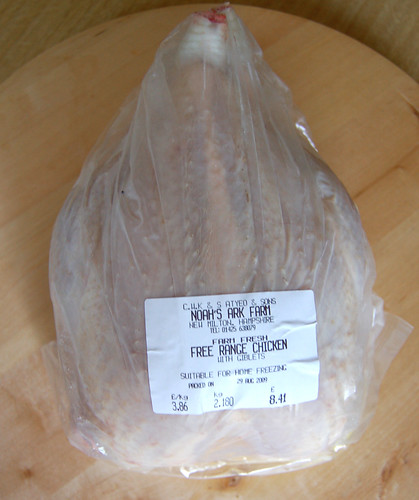
Week Two: Noah's Ark Free Range Chicken

So, here’s the bird – £8.41, not too bad. And with giblets… scary! Luckily, these were bagged and were swiftly removed to the freezer. I haven’t come across a recipe that needs them yet, but I’m sure I will, and it always seems to be when you don’t actually have any… I’ve had a traumatic past experience with giblets which gives me a totally legitimate reason to get freaked out by them, I’ll have you know. As a spotty youth I was charged with making the roast dinner at my uncle’s house one Sunday, and, for some reason, this involved me submerging a whole chicken in a sink of water, probably to defrost it. As I did so, the cavity filled with water, and out popped a dishevelled brown bag filled with chicken guts, which promptly exploded and covered my hands and the dead chicken with scraps of heart and liver. Ugh. I tend to keep away from guts now…

Anyway, so. Here’s the costing:

Noah’s Ark free range chicken, 2.2kg : £8.41
Tesco chorizo sausage : £2.99
2 for 1 baby potatoes, costed for one 1kg packet : 59p
4 lemons : £1.00
Bunch parsley : 79p
Garlic : 20p

Grand total : £13.71

Chorizo is so damn expensive, but luckily, it’s totally worth it.

Week Two: Ingredients for Gremolata

So, Jamie wants you to make a (looks it up) gremolata, which is chopped lemon zest, raw garlic and parsley. Never made this before, and it was delicious. I don’t know that it will be my condiment of choice for roast chicken hereafter, but a little exploration is what it’s all about, right?

Note that Jamie’s recipe calls for a beaten egg – this phantom egg doesn’t appear in his online version, but it’s been confuddling cooks online for a while, because it never gets used in the recipe. I think maybe Jamie just wants you to beat an egg for this recipe so that you can ponder that age old question – which came first? His answer being, presumably, that the egg never came at all. Wow, philosophical…

Week Two: Super Tasty Spanish Roast Chicken

So, here is the chicken all dressed up and ready to party. The cavity is filled with hot lemons and parsley stalks – I definitely will always boil my lemons first before adding them to a chicken to roast. I first came across this in another Jamie recipe and it really helps the lemon scent to flavour the bird – it steams it in lemon scent. Of course, I am an idiot, and I turned the oven off about ten minutes before this step, so the chicken had to sit on the side and generate some delightful bacteria before I could put it in the oven. No, luckily that didn’t happen, but obviously hot food + raw poultry + sitting around = bad idea.

Before you pop the chook in the oven, though, you have to cover it in damp parchment paper, which ‘seal in the juices’. I have to say, this part didn’t work so well for me. The paper got quite burned, and left a bitter taste to the flesh and juices, and charred paper also coloured the stock a muddy grey. I don’t know how necessary it is, but I might use foil if I did it again… Which I won’t for a WHOLE YEAR. Probably.

Week Two: Super Tasty Spanish Roast Chicken meal

This is the stunt double meal – like I said, by the time I got to serving dinner, the light had totally gone, but luckily there was enough left over for me to take this shot the next day.

I served the chicken with ratatouille and Leon’s Magic Beans, and it was delicious.

Week Two: Super Tasty Spanish Roast Chicken meat 'n' taters

Scores:

M gave it 8.5. He likes chorizo, he likes chicken, he likes potatoes. Altogether, a pretty good combo. The gremolata went down well, so a good success. But he did wonder how it was possible to ever score a 10, and frankly, so do I…

I gave it 8. I really liked it, but it somehow wasn’t chorizoy enough for me. I wanted the rich, greasy, spicy taste of the chorizo, cut with the zesty fire of the fresh lemon. It was a lot more subtle than that. Also, the parchment paper really didn’t do well on top, and I didn’t like having grey gravy… And, as per Jamie’s instructions, I sprinkled parsley on the top, which was a mistake, as it pretty much got cremated and turned very bitter. On the up side, it made delicious spuds and we had loads for lunch the next day!

Week Two: Super Tasty Spanish Roast Chicken meat 'n' taters closeup

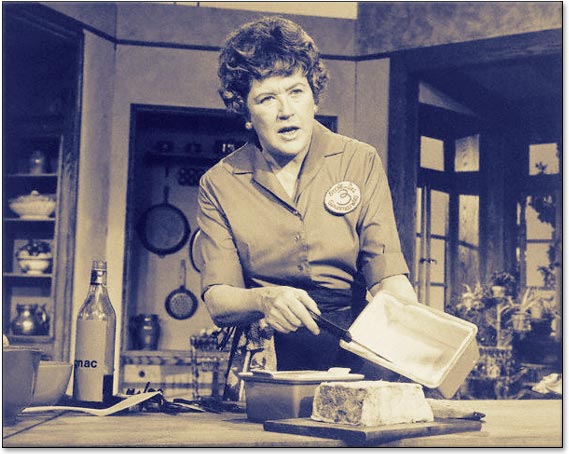
Julia Child and Yan Can Cook

When I was a kid, me and my mum would watch the food channel on cable TV endlessly. I really miss those programmes. Nowadays we have loads of UK-centric programmes and British food celebrities like Nigella Lawson and Jamie Oliver. But when I was little and I wanted to watch a TV programme, who I really wanted to watch was Julia Child and Martin Yan.

Julia Child isn’t particularly well known in the UK, but she’s hugely loved in America. What I loved about her, apart from her crazy voice, was her slapdash attitude which saw food flicking all over the place. Yet somehow, out of what I perceived to be culinary chaos, she managed to turn out pretty damn good dishes. To be honest, I loved Julia Child more for the comedy value, but the more I’ve learned about her since I’ve also come to respect her as an accomplished chef. I’d love to read her book Mastering the Art of French Cooking, especially after starting to read The Julie/Julia Project. It seems as though the foodie world is aflame with plenty of Julia love, thanks to the recent movie based on the blog, starring Meryl Streep. The film hasn’t come out in the UK yet, but I don’t think it’ll make great waves here – as I’ve said, Julia Child isn’t really a big name for the British public. Our equilvalent is, of course, the reliable and slightly fiesty Delia Smith.

Now, Martin Yan. All I really remember is him shouting ‘if Yan can cook, so can you!’, then furiously chopping some vegetable into ridiculously thin slices, or pulling off some amazing feat of culinary skill totally beyond the realm of normal people. I can safely say, Martin Yan has more skill in the kitchen than I ever will, but his infectious, goofy presenting style also won my girlish heart. Bless him! Completely coincidentally, he’s also the author of Chinese Cooking for Dummies, which sits proudly on my bookshelf near Sushi for Dummies, Puppies for Dummies and Cats for Dummies. All fantastic recipe books.

“Set it aside!”

Dishing the dirt on Thanksgiving 2008

I’ve already mentioned that I love Thanksgiving. It allows me to, without constraints of expectation, indulge in a huge amount of culinary exploration, cook scores of brand new dishes, obsess for days and days over what I’m going to cook, and buy loads of new cookbooks. Oh, and look at photos of Thanksgiving tables on Flickr for hours to figure out what everything’s supposed to look like. None of my friends or family really know what it’s all supposed to taste like, so whether it’s a disaster or a triumph, it’s going to get eaten just the same.

However, I do tend to get carried away.

This is blindingly obvious to you, I’m sure, having read the first paragraph. Gemma’s rule of cooking number one, is why cook one dish, when you can cook three? Last year, that was translated into Thanksgiving terms as, why only have roast potatoes, when you can have three kinds? Also, why have two side dishes, when you can have seven? And, why not do it all, barring the intervention of my sainted mother, pretty much by yourself?

My long suffering mother helped here with the cooking, and she laid the table and provided the house and kitchen that hosted these festivities, but when it comes to the kitchen, I’m a bit of a lone ranger. There’s no way I expect other people to have the same kind of dogged determination as I do when it comes to these epic feasts. Besides, life’s no fun unless you’re pitting your very being against the clock. If I ever thought anything to do with cooking was easy, my first instinct has always been to make it harder. More of everything! Double the quantities! Can we fit in another course?

So, mostly for the purposes of self-gratification, here’s my menu from Thanksgiving, 2008.

Thanksgiving Menu

Appetiser
Winter squash soup with prosciutto and sage
Seasonal pate and toast

Main Course
Savoury apple-onion turkey with
a selection of American apple-cider gravy or traditional English gravy

Potato Dishes
Traditional English roast potatoes
Classic Thanksgiving mashed potatoes
Thanksgiving sweet potatoes

Side Dishes
Mixed winter vegetables
Lemon-butter green bean casserole
Classic Thanksgiving corn pudding
Cheddar-scalloped baby onions
Thanksgiving dressing
Traditional English sage and onion stuffing
Homemade cranberry sauce

Dessert
Pumpkin pie
Chunky peanut, chocolate and cinnamon cookies
Both served with cream and vanilla icecream

So, let’s break it down.

My soup starter came from Thanksgiving 101, by Rick Rodgers, page 21. It’s basically a creamy butternut squash soup with salty, savoury ribbons of pink Italian air-dried ham stirred in, and was really nice. I’d make it again for Thanksgiving, but like a lot of the things I eat for this stolen American holiday, I wouldn’t eat it any other time. The pate is a bit of a cop-out, shop-bought and served with toast, a bit of a concession to the fussy eaters in the family. As you can see from the rest of the menu, there’s a lot of that going on!

Savoury Apple-Onion Turkey, and the accompanying gravy, came from Betty Crocker’s Complete Thanksgiving Cookbook, page 20-1. I don’t remember this being amazing, but I think the gravy was a bit of a disaster. I’ve never made a gravy I’ve liked that wasn’t our family recipe. This is not the fault of other gravy, or particularly an indication of the greatness of our gravy. I just can’t get along with other gravies, or I completely have no clue how to make gravy ‘properly’. I’d love to make a gravy I liked, but if I want something to satisfy my gravy urge, I have to break out the roast juices, Bisto powder and Oxo cubes. For shame! Other people liked the apple cider gravy, but I could happily never have it again.

The roasties are self-explainatory, but the classic mashed potatoes are another Betty Crocker recipe, same book, page 71. However, since then, I have discovered the ultimate mashed potato recipe in Sheila Lukins’ bloody fantastic USA Cookbook. It’s called Garlicky Red-Jacket Mashed Potatoes, and it is the only mashed potato recipe I’ll ever bother with. It involves cider vinegar (ha ha, a use for that new bottle of Norman cider vinegar I brought back from my holiday), sour cream and red potatoes, and it’s glorious. Bless Sheila Lukins and her kick-ass cookery book. I’m slowly reading every single recipe in there like it’s my new religion, and I can also whole-heartedly recommend her awesome Tomato Balsamic Vinaigrette, which is so good I don’t mind how fiddly it is. Anyway. The sweet potatoes were actually slow cooked, another good old BC recipe (page 79 – I hope someone’s using these… who am I kidding?). I don’t think anyone ate them.

Mixed winter vegetables were my mum’s contribution, which I think were just boiled cauliflower and cabbage or something. Lemon-butter green bean casserole is a Nigella recipe, which has been on the table every year since I started my Thanksgiving tradition. It’s not really a proper green bean casserole as I understand it, but it’s basically lemon guts and juice, with copious amounts of butter, pepper and salt. Delicious. Also good whenever I get green beans, which isn’t often, but I do love them.

The corn pudding is another BC recipe (Classic Baked Corn Pudding, page 83). Really tasty, this is basically loads of milk, loads of eggs, loads of cheese, and obviously sweetcorn and breadcrumbs. It was tasty and heart-blocking. Totally unlike anything else I ever eat, and I might cook it again another year.

Cheddar-scalloped baby onions was equally artery-clogging and came from Thanksgiving 101 (page 81) and was a more elaborate version of Creamed Onions. As I said before, why make the simplest version of anything when you can complicate matters further, especially if that complication comes in the form of cheese?

The Thanksgiving Dressing I have no memory whatsoever of. The English version was Paxo. I love Paxo. Forget the poncy versions they come up with, sage and onion stuffing cannot be bettered. To try is an utterly pointless waste of time. Paxo rocks. For the cranberry sauce, again, a blank. It might very well have been the Fresh Cranberry-Orange Relish from Thanksgiving 101, page 94. But then again, maybe it wasn’t.

For my pumpkin pie, I procured a stupidly expensive can of Libby’s pumpkin puree, and followed the instructions on that. I read in Thanksgiving 101 that Libby’s reckon 55 million pies are made from that recipe every year, so who am I to argue in my pursuit of the real American experience?

Chunky peanut, chocolate and cinnamon cookies are courtesy of Martha Stewart via a Thanksgiving copy of Martha Stewart Living I picked up in New York a few years back. I feel like I have my Holy Trinity of Thanksgiving Gurus lined up here – Martha, Betty and Nigella. (Except, of course, that Betty isn’t actually a real person… Fictional gurus are still pretty kick ass, though.) The first chapter of Nigella’s Feast is the first time I’d ever read Thanksgiving recipes, which didn’t exactly kick-start my obsession, but it certainly added fuel to the fire. These cookies are great to have in the freezer, and wound up lasting me until the next year. Delicious! American cookie recipes always seem to yield about three dozen cookies, which is great if you want freezer fodder. If you didn’t freeze them all, though, how the hell would you get rid of them?

As a last minute, why have two puddings when you can have three kind of addition, I also made Dark Chocolate Cream Pie from Thanksgiving 101 (page 121), which went down very well indeed.

So, there’s the dirt on last year… I wonder what I’ll do this year?